
MOEF Import Permission of Used Tyres in India: Complete 2026 Guide
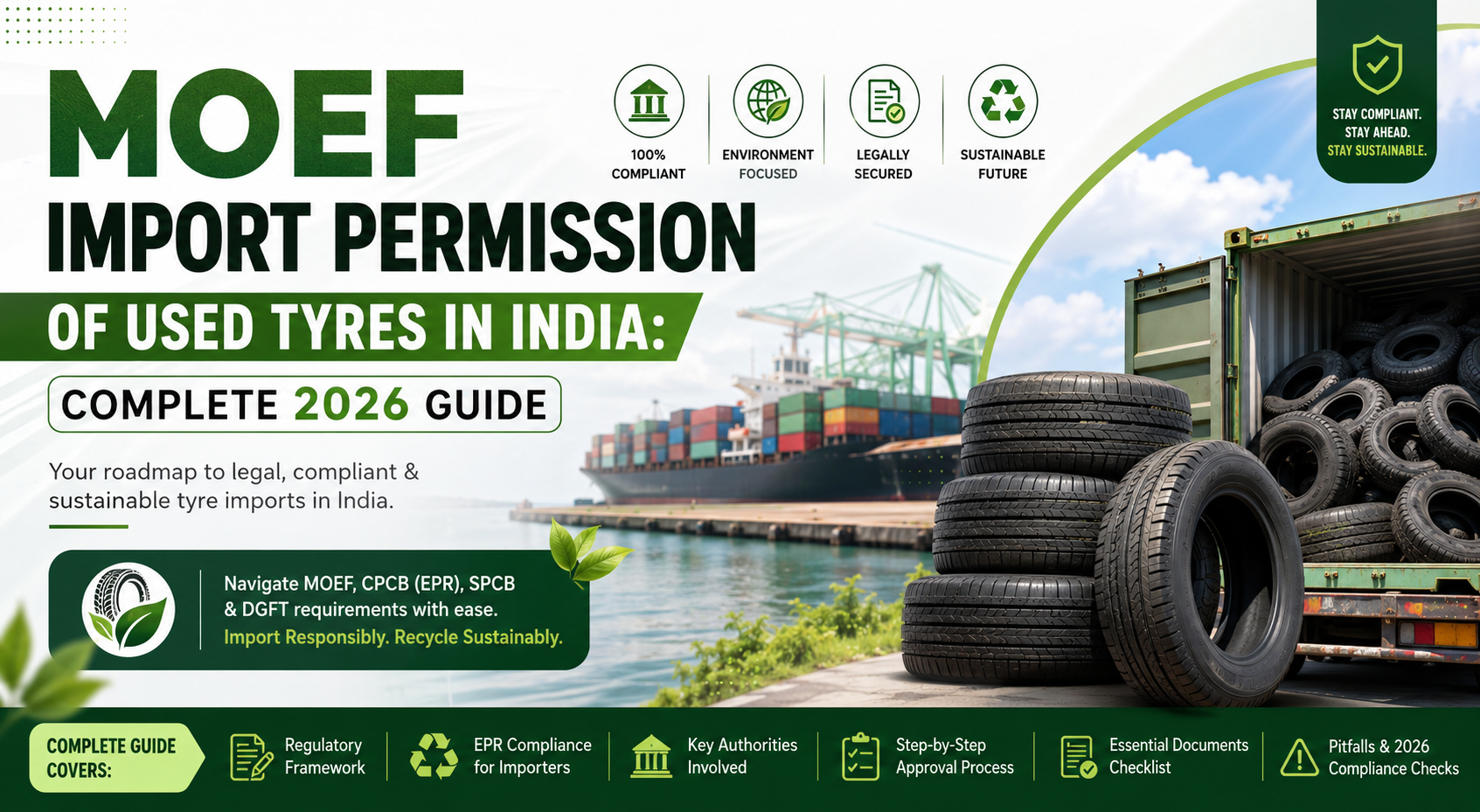
Welcome to the CERTILIZE official blog! In case you are in the recycling business or are intending to venture into the fast growing waste management business in India, importing used tyres is a great opportunity. Nevertheless, it is not an easy task. By 2026 the regulations are extremely structured, digitally monitored and environmentally strict.
The importation of used tyres into India is regulated by the following requirements: permission to import used tyres into India is issued by the Ministry of Environment, Forest and Climate Change (MoEF&CC), compliance with Extended Producer Responsibility (EPR) requirements by the Central Pollution Control Board (CPCB), and the issue of a limited importation license by the Directorate General of Foreign Trade (DGFT).
This CERTILIZE guide will give a clear picture of what is required of a legal framework, compliance requirements, and the steps involved in obtaining MoEF import permission in 2026.
1. Regulatory Environment of Tyre Imports
India is among the biggest consumers of rubber and produces a huge amount of waste tyres. Domestic scrap is however usually either inadequate or too expensive to recycle by the recycling industries, therefore imports are necessary. Although this is necessary, the government highly regulates the importation of tyres in the country to ensure that India does not become a dumping ground of the hazardous waste.
The regulation is Hazardous and Other Wastes (Management and Transboundary Movement) Rules, 2016. Under these regulations, the used tyres will be classified as Schedule III, Part B, that is, in terms of importation, they will be restricted and their importation is allowed only on the basis of recycling and recovery. It is strictly not to be disposed of or landfilled.
The biggest change came in the form of the introduction of Extended Producer Responsibility (EPR) of waste tyres in 2022. By the year 2026, EPR is a key compliance need. The importers are treated as producers which means that they are liable to ensure that the tyres they bring to the country are properly recycled. This is a responsibility that is monitored using a digital system that will measure the output of recycling and compliance using EPR certificates.
2. Authorised vs. Unauthorised Uses of Imported Tyres
Prior to seeking MoEF permission, it is important to make sure that the proposed use of imported tyres is in compliance with the regulatory requirements. The Expert Committee of MoEF&CC is a serious appraiser of the end-use of imported tyres and refuses to consider applications that fail to meet the required standards.
Importations are only allowed when they are consumed by actual users, i. e. the businesses are supposed to have their own recycling plants. The tyres should be subjected to value added products like crumb rubber, reclaim rubber, crumb rubber modified bitumen used in road construction or recovered carbon black. It is also permitted to re-retread, but only when there are stringent quality requirements.
Meanwhile, some applications are strictly forbidden. The prohibition of the importation of tyres to be used in the production of the pyrolysis oil is the most significant restriction of 2026. This limitation has been imposed because of environmental issues, as unregulated pyrolysis units have historically resulted in severe pollution. Although domestic tyres may still be utilized in extremely regulated pyrolysis facilities, the importation of tyres to facilitate this purpose is not possible. The CPCB has compliance measures by using digital tracking systems that trace the flow and processing of imported tyres.
Chapter 3: Making the 2026 EPR Mandate on Importers
The most crucial requirement to import used tyres in 2026 is EPR compliance. It is non-negotiable and has to be met prior to permission to operate by MoEF.
The importers under the EPR framework must comply with an obligation to recycle 100 percent of the products. This implies that the amount of tyres imported in a year must be accompanied by a similar amount of recycling the next year. An example would be to have an importer to bring in 10,000 metric tonnes of tyres in one year, in this case, the importer will be required to ensure that the same quantity is recycled in the following year.
This requirement can be met by registering in the portal CPCB EPR and buying EPR certificates at the recyclers of authorized status. In case the importer has their own recycling plant, the production of their plant could produce these certificates. Also, periodic returns have to be filed by importers, and the CPCB portal cross-checks data to avoid discrepancy or abuse.
In 2026, the compliance regime has been tightened. To high-volume importers, in particular, those that currently have import volumes of more than 30,000 metric tonnes per year, verification of EPR compliance is compulsory before new import authorisations are given. Any discrepancy between the amounts of imports and the credits in EPR may cause applications to be rejected or postponed.
Chapter 4: The Main Authorities involved
When importing used tyres, there is a relationship with various regulatory bodies and each has a specific role to play.
A. State Pollution Control Board: The first authority which makes sure that your facility is legally up to date is the State Pollution Control Board. It gives Consent to establish and Consent to Operate, which determine your production capacity and activities that are permitted. The MoEF will not give any permission to import in excess of the capacity which has been approved by the SPCB.
B. Central Pollution Control Board: The EPR is managed by Central Pollution Control Board, which issues standard operating procedures, and conducts inspections to ensure compliance with the environment.
C. Ministry of Environment, Forest and Climate Change: The main authority, which grants import permission by its Expert Committee, is the Ministry of Environment, Forest and Climate Change. It checks the applications, evaluates compliance and decides how many imports may be made.
D. Directorate General of Foreign Trade: The restricted import license is issued by the Directorate General of Foreign Trade without which, imports are not cleared at the customs.
E. Customs officials: The customs officials check all approvals and make sure that it is followed at the port of entry.
5. Step-by-Step Guide to MOEF Permission in 2026
Step 1: The MoEF permission process is a meticulously planned process to be followed strictly. It starts by the setup of a fully operational recycling plant with the right equipment and pollution mitigation systems. Applications are not taken into consideration without a physical facility.
Step 2: The second one is receiving Consent to Establish and Consent to Operate of the State Pollution Control Board. Such approvals are obligated to explicitly stipulate the production capacity and form of recycling operations.
Step 3: Following this, the applicant should enroll on the CPCB EPR portal and make sure to comply with the EPR requirements. This is an important step, without a valid registration of EPR, MoEF will not process applications.
Step 4: The application for import permission is then submitted through the MoEF online portal, along with Form 5 and supporting documents. The applicant should demonstrate the necessity of imports and give a detailed process flow chart on how the tyres will be recycled safely.
Step 5: Expert Committee reviews the application. In the case of a new applicant, a smaller number is normally granted at first, and a site inspection is required. The current applicants are assessed on the previous compliance, production statistics, and inspection records.
Step 6: After receiving MoEF approval, the applicant should seek a restricted import license by DGFT. Once this license is obtained the imported goods can be cleared with the help of customs. It is also required of the importers that the tyres should be handled within the time frame stipulated by MoEF and should also maintain the proper records which can be verified in the future.
6. Documents Checklist that is important
Documentation is an important aspect of getting approval. Applicants should submit the incorporation documents of the company such as PAN, GST registration, and Import Export Code. There must be valid SPCB consents, as well as evidence of EPR registration.
The application should contain Form 5, comprehensive process flow chart, and demonstration of production capacity. In the case of the existing units, other documents like GST returns, electricity bills, and financial statements would be required to prove the actual operations and value addition.
To certify financial and production information, a certificate issued by a Chartered Accountant is usually required. Any lost or wrong document may lead to delays or rejection of the application.
7. Pitfalls and Strict 2026 Compliance Checks
The regulatory authorities in 2026 are stringent and applications are closely examined.
- Among them is low value addition where the authorities are suspecting that there is no actual recycling going on. This has been evaluated by the amount of GST and financial records.
- Rejection may also be caused by poor pollution control measures. The facilities will have to abide by the environmental standards and any shortcoming that is detected during the inspections may lead to refusal of permission.
- Mostly rejection is due to failure to achieve EPR targets. The authorities ensure that the importer has met the past obligations before giving new approvals.
- Also, over dependence on imports without sourcing domestic waste could result in decreased import quotas with the government promoting a balanced procurement. Any discrepancy between the stated capacity, production statistics and electricity consumption can also be an issue and a source of suspicion.
Conclusion
The opportunity of importing used tyres into India is a profitable one, though it has to be under a very complex system of regulations. It is done through several approvals, documentation, and constant monitoring. The smallest mistake can slow down or interfere with the operations.
CERTILIZE offers end to end support in going through this process, including EPR registration, MoEF documentation, SPCB approvals, and DGFT licensing. When a business is properly guided by experts and with updated knowledge on changes in the regulatory arena, the business is able to operate smoothly and within the confines of the law.
Collaborate with CERTILIZE to streamline the process and concentrate on creating a successful recycling venture without compromising with the Indian environmental laws completely.
Frequently Asked Questions
-
Is MOEF permission mandatory for importing used tyres into India?
Yes, MOEF permission is mandatory for importing used tyres into India. Importers must also comply with CPCB EPR regulations, obtain SPCB approvals, and secure a restricted import license from DGFT before customs clearance.
-
Can imported used tyres be used for pyrolysis oil production in India?
No, imported used tyres cannot be used for pyrolysis oil production in India in 2026. The government has imposed strict restrictions due to environmental concerns and pollution risks associated with unregulated pyrolysis operations.
-
What documents are required for MOEF import permission of used tyres?
Key documents include PAN, GST registration, Import Export Code (IEC), SPCB Consent to Establish and Operate, EPR registration proof, Form 5, process flow chart, financial statements, GST returns, and a Chartered Accountant certificate.