On this page
- Introduction
- Mandatory Licenses and Certifications
- Name and Estimated Cost related to Machinery & Equipment –
- Total Estimated Plant Cost:
- Process related to Battery Recycling
- Market Summary
- Business Potential:
- EPR Benefits for Battery Recyclers
- CERTILIZE deliver services:
- Why CERTILIZE?
- Are you ready to Start Your Battery Recycling Venture with certilize?
Introduction
Battery consumption has surged worldwide with the exponential growth in mobile devices, electric vehicles, and renewable energy storage systems. The growing usage of lithium-ion and lead-acid battery in India has led to a massive increase in battery waste. As the batteries contains heavy metals and chemicals it needs to be treated or else used batteries may pose significant threats to human health and the environment.
Recycling of Battery has become a crucial part of India’s environmental and economic landscape. Through Proper recycling it is possible to recover valuable materials like lead, lithium, cobalt, and nickel and it also helps to stop the harm to the environment. As per the Battery Waste Management Rules, 2022, introducing Extended Producer Responsibility (EPR) obligations for manufacturers, importers, and recyclers the Government of India has implemented stringent rules.
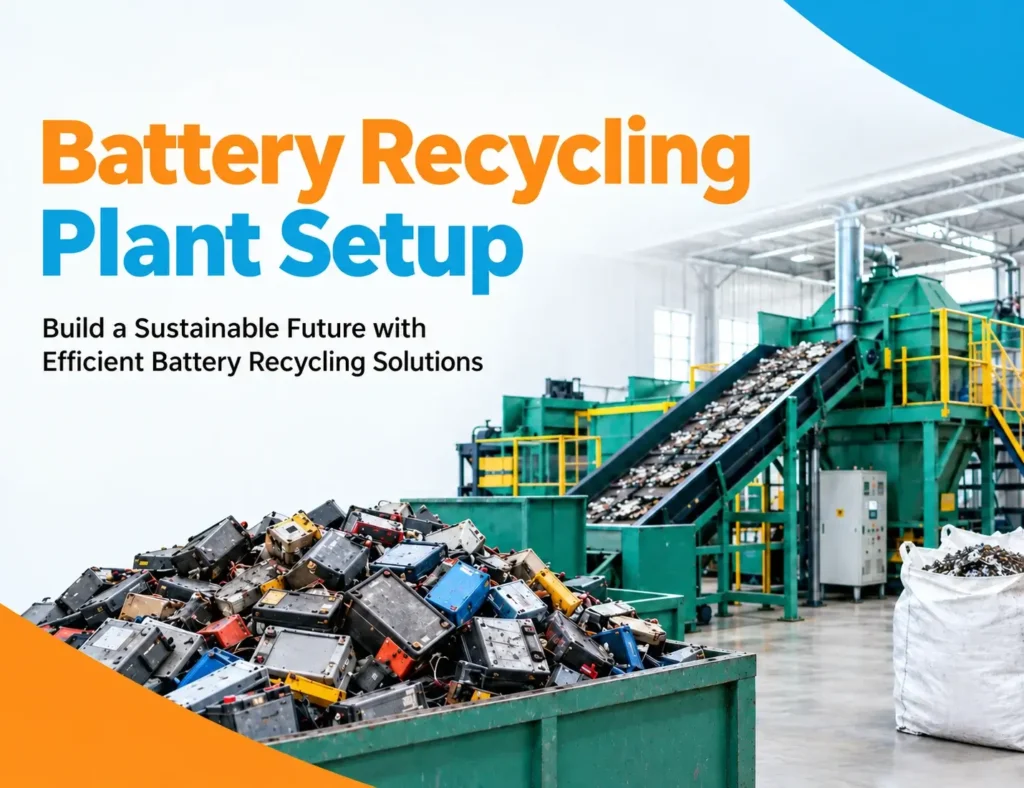
Battery plant for the purpose of recycling is a business that helps to clean the environment; by setting up a recycling plant one can gain profit as well as heal the environment from the pollution. At certilize we provide entire service that includes setting up a recycling unit, applying for required license, technology planning or epr compliance etc.
Mandatory Licenses and Certifications
To start and function a battery recycling plant in India lawfully you need the license and permissions that are listed below: –
- Documents related to company in case proprietorship pan/adhar
- From State Pollution Control Board (SPCB) Consent to Establish (CTE) and Consent to Operate (CTO)
- From CPCB (Central Pollution Control Board) Authorization under Battery Waste Management Rules, 2022
- Authoriztion for Hazardous Waste Authorization if you are handling lead, lithium etc.
- Factory License
- Fire and Safety NOC
- Occupational Health & Safety Compliance
- GST Registration
- Import/Export License (IEC)
- EPR Registration for Recyclers ith CPCB to participate in EPR credit system
We at CERTILIZE handle everything from start to scratch whether it is related to documentation, application or renewal applications.
Name and Estimated Cost related to Machinery & Equipment –
The type of machinery depends on the battery type (lead-acid vs lithium-ion). Below is a sample setup for each:
Lead-Acid Battery Recycling
| Machine Name | Function | Approx. Cost (INR) |
| Battery Cutting Machine | Opens used batteries | ₹3,00,000 |
| Acid Neutralization Tank | Neutralizes and treats battery acid | ₹2,00,000 |
| Lead Separation Unit | Extracts lead and plates | ₹3,50,000 |
| Plastic Crusher and Cleaner | Separates and washes battery casing | ₹2,50,000 |
| Smelting Furnace (Rotary) | Melts and purifies recovered lead | ₹7,00,000 |
| Fume Extraction System | Controls emissions and acid vapors | ₹3,00,000 |
| Moulding Machines | For lead ingots | ₹1,50,000 |
Lithium-ion Battery Recycling (Black Mass Recovery)
| Machine Name | Function | Approx. Cost (INR) |
| Battery Discharging Unit | Safely discharges residual power | ₹3,00,000 |
| Crusher/Shredder Unit | Crushes batteries into small parts | ₹5,00,000 |
| Separator Unit (Airflow/Vacuum) | Separates plastic, aluminium, copper | ₹3,50,000 |
| Pyrolysis Furnace (for solvents) | Optional for advanced recovery | ₹10,00,000 |
| Electrostatic Separator | For black mass collection | ₹5,00,000 |
| Dust Collection & Filtration | Captures hazardous particles | ₹2,00,000 |
Total Estimated Plant Cost:
- Lead-acid unit will cost upto ₹25–35 Lakhs
- Lithium-ion unit will cost upto ₹40–60 Lakhs (black mass recovery only)
CERTILIZE helps you get the CE-certified machines from reputed vendors and proposed to turn key machinery setup.
Process related to Battery Recycling
Battery Recycling – Lead-Acid
- At first, collect the used batteries from manufacturers, scrap dealers or other places which deals with battery and sort the type.
- Secondly, to extract lead plates, acid and plastic cut the batteries open.
- Thirdly, to reuse it convert to sodium sulphate or neutralize sulphuric acid.
- Fourthly, melt the lead by using furnace and cast into ingots.
- Lastly, do cleaning of the battery casing and sell that to plastic reprocessors
Battery Recycling – Lithium-Ion
- First Step- to avoid fires remove the residue charge the process is known as safe discharging
- Second Step- Breaking of batteries into small fractions i.e. crushing or shredding.
- Third Step- To separate black mass, copper, aluminium and plastic use airflow, vibration and electrostatics.
- Fourth Step- Recovery of black mass like (Li, Co, Ni, Mn)
- Fifth Step for element extraction Send black mass to hydrometallurgy facility, it is optional.
Market Summary
- By 2030 India’s battery market anticipated to reach ₹1.2 lakh crore
- Boom in EV lead to huge volume of lithium-ion waste
- Target of Government: under BWM Rules 100% recycling of end-of-life batteries
- Main sectors: EVs, solar power storage, telecom towers, consumer electronics, UPS
- Black mass imports has increased demands even countries like China, EU, and US are demanding it.
Business Potential:
- Steady supply from battery producers
- High-value recovery (₹100–₹800/kg for materials)
- EPR credits generate extra income
EPR Benefits for Battery Recyclers
As per Battery Waste Management Rules, 2022, producers must meet annual recycling targets.
- If you register as an authorized recycler:
- Generate EPR credits for every kg of battery recycled
- Sell credits to brands, OEMs, importers
- Long-term tie-ups with battery producers
- Listed on CPCB’s authorized recycler portal
CERTILIZE deliver services:
- Registration of EPR
- system setup to track Credit
- compliance filing monthly/annually
- Producer linkage support
Why CERTILIZE?
CERTILIZE is a forerunner in battery recycling consultancy with:
- 160+ environmental plant setups completed
- Registered vendors for CPCB/SPCB approvals
- In-house experts in legal, licensing & EPR
- vendors access in buying or selling of lead, black mass, and battery scrap
- Turnkey solution: from innovation to plant commissioning
Are you ready to Start Your Battery Recycling Venture with certilize?
Battery recycling is not just money-making — it is significant for a sustainable future. CERTILIZE helps start-ups, businesses and industries to launch fully compliant and successful recycling plants that meet growing energy and waste management needs in India.
Frequently asked questions
Is battery recycling legal in India?
Yes, it is legal in India but with the authorization under Battery Waste Management Rules, 2022.
Can I recycle both lead and lithium batteries in one plant?
Technically yes, but you will need separate machines and lines for safe handling.
What do you mean by black mass?
A fine powder substance extracted from Li-ion batteries that contains lithium, cobalt, and nickel.
Are there any government subsidies for this plant?
Yes. The government subsidies are PMEGP, MSME, and green industry schemes that offers support.
What is the ROI for a battery recycling unit?
Generally, it takes 18–24 months depending on the capacity, EPR tie-ups, and material resale.
What are the safety precautions required?
The safety precautions that are required - Fire safety, acid proof flooring, PPE for workers, and fume control systems.
What happens to the extracted materials?
The extracted materials are used in the following ways- Lead and black mass are sold to smelters or refiners for reusing into new batteries.
What is the minimum land required?
For a 2–5 TPD plant at least 10,000 sq. ft. of land is required.
Can I export black mass?
Yes, if you have proper DGFT license and hazardous waste compliance.
How do I get raw material?
To get raw materials Tie-up with battery manufacturers, service centres, EV dealerships, and scrap dealers.