
Complete Guide to Exporting Spent Catalyst from India
Introduction
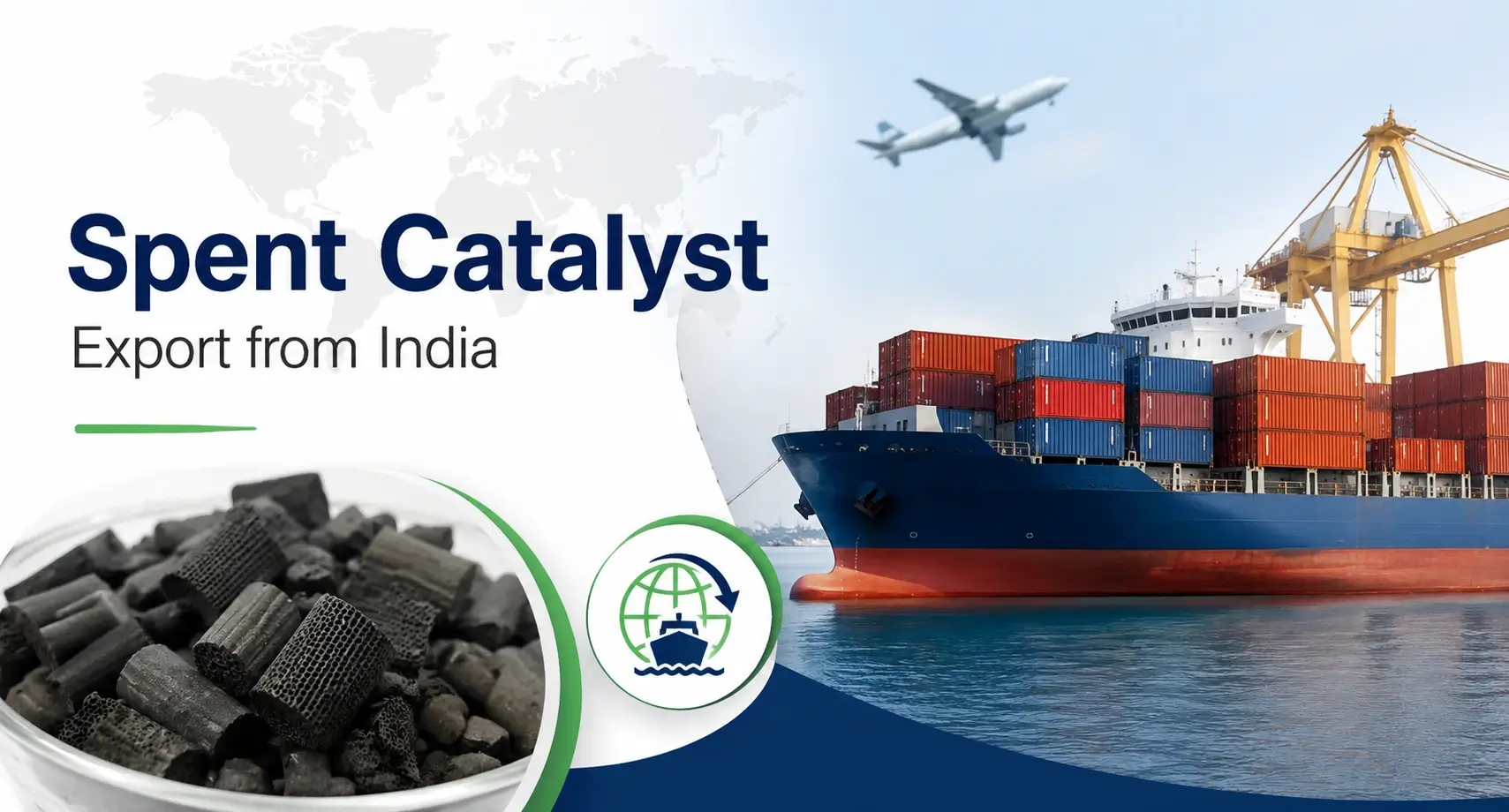
Spent catalysts are the products that contain metals like platinum, palladium, rhodium, nickel, cobalt, molybdenum, vanadium, tungsten, copper and many others. These are the products from the petroleum industry, petroleum refining, petrochemical industry, fertilizer industry, specialty chemical industry, fine chemical industry and pharmaceutical industry.
Spent catalysts taken from these industries are chosen for their exportation, to countries where they can extract platinum group metals including platinum, palladium and rhodium because of the efficient recovery process used by these countries for exporting the spent catalysts to India.
What is a Spent Catalyst?
Spent catalysts are catalysts that do not work like they used to. They cannot help make reactions happen anymore. This happens for a lot of reasons. Even though spent catalysts are not good for helping reactions happen they can still have some things in them. These valuable things are called base metals. We can recycle these base metals. Spent catalysts can have metals, like platinum, palladium and rhodium in them. They can also have nickel, cobalt and molybdenum. Sometimes spent catalysts even have vanadium, tungsten and copper in them. Spent catalysts can have other kinds of base metals or precious metals in them too.
Industries that Generate Spent Catalysts
The following industries can generate spent catalysts:
- Petroleum Refineries
- Petrochemical Plants
- Fertiliser Manufacturing Units
- Pharmaceutical Industries
- Speciality Chemical Manufacturers
- Hydrogenation Plants
- Edible Oil Processing Units
- Fine Chemical Industries
- Environmental Catalytic Treatment Facilities
- Automobile Industries
Why Do Companies Export Spent Catalysts?
Benefits of exporting spent catalysts:
- Recovery of valuable precious and base metals
- Environment- friendly recycling method
- Meeting legal requirements for waste management agencies
- Better recovery due to the latest technology used in the overseas refinery
- Lower disposal cost
- Conservation of resources
Is export of spent catalyst allowed in India?
Export of spent catalyst is allowed from India by following the procedure advised by the environmental, foreign trade, customs and other regulatory authorities. The following factors need to be considered for export of spent catalyst:
- Chemical composition,
- Hazardous components present, if any,
- Metal content,
- Applicable HS code,
- Hazardous and Other Wastes rules and
- Import requirements of the country of import.
The above aspects vary for each shipment of spent catalyst, and hence every consignment needs to be evaluated separately before export.
The following agencies may be involved in export of spent catalyst:
- Ministry of Environment, Forest and Climate Change,
- State Pollution Control Board,
- Indian Customs and Ports.
List of applicable regulations for export of spent catalyst:
The exporter have to comply with the following regulations:
- Hazardous and Other Wastes (Management and Transboundary Movement) Rules, 2016
- Foreign Trade Policy
- Customs Act
- Basel convention on the control of transboundary movements of hazardous wastes and their disposal
- Other applicable shipping regulations.
Steps involved in exporting spent catalyst:
The following steps are involved in exporting spent catalyst:
- Testing of material to determine the % of metal content and other hazardous properties.
- Determine the correct Harmonised System of Coding and Tariff (HSN) code because the classification of goods under this code determines the type of approval required for export and other customs formalities. In case of incorrect code submission, the customs might not accept the description and the shipment might be detained.
- Determine if the spent catalyst is hazardous waste based on the Hazardous and Other Wastes (Management and Transboundary Movement) Rules, 2016.
- Apply for required approvals from the environmental regulatory authority. Based on the material, the environmental authority may require details about:
- Manufacturing process
- Source of catalyst
- Recovery process
- Details of authorised recycler
- The following documents may be required by the authority while seeking their consent are as mentioned below:
- Consent to Operate CTO
- Hazardous waste authorisation
- Other consents as may be specified by the State Pollution Control Board.
- Get agreement from the overseas recycler for processing the spent catalyst. The overseas recycler should have necessary approvals from the local regulatory authorities for importing and processing spent catalyst. They should also have the equipment and technology for recovering metals from the spent catalyst.
- Apply for permission from MOEF. Documents required for applying for permission from MOEF:
- justification for export
- insurance policy
- PAN card of unit
- COI
- Buyer-seller agreement
- Lab report
- CTO and Authorisation
- Basel No
- Port of export
- Prepare Export DocumentationSome of the documents include:
- Commercial invoice
- Packing list
- Purchase order
- Material safety data sheet (MSDS/SDS) if applicable
- Lab test report
- Certificate of analysis(COA)
- Hazardous waste authorization
- MOEF approvals
- Shipping documents
- Import permission from the destination country if applicable
- Customs documents
Depending upon the destination country and material classification, there might be additional documents required.
- Customs Clearance
After required approvals, the shipment is cleared through Indian Customs for export.
Documents required
- IEC
- GST Registration
- PAN
- Company Incorporation documents
- Hazardous waste authorization
- Consent to operate
- MOEF Permission
- Lab analysis report
- COA
- Commercial invoice
- Packing list
- Purchase order
- SDS/MSDS
- Export contract
- Shipping bill
- Post-clearance
- Insurance documents
- Importer’s authorisation (if applicable)
Challenges Faced By Exporters
Major exporters usually face one or more of the following issues:
- Wrong categorisation of waste material
- Wrong category or HS code
- Documentation issues
- Lack of lab report
- Non-adherence to environment clearance norms
- Customs declaration errors
- Delay in getting necessary approvals
- Import restrictions of the destination country
- Proper planning and documentation can help avoid most of these issues.
Best Practices For Export
The following best practices can help ensure a smooth export process:
- Test the material thoroughly
- Confirm the relevant HS code
- Understand the applicable regulatory requirements
- Confirm if the overseas unit is authorised to receive the particular waste material
- Make sure that all the approvals and clearances are in place before export
- Maintain traceability documentation at all times
- Consult with experts to ensure that all the compliances are followed
Why is important to follow all Precautions and Regulations?
Spent catalyst exports require compliance with various environmental laws and international regulations regarding shipping goods overseas. In case you lack knowledge about these regulations, you may end up suffering from more delays or even lose money. Thus, it is important to ensure that all the processes and regulations are followed when shipping your spent catalysts.
Conclusion
The export of spent catalysts from India requires a responsible approach, detailed analysis of materials, appropriate documentation preparation, and knowledge of regulatory requirements. At the same time, businesses that understand the intricacies of the process and are prepared to provide all the necessary documents will reduce delays in the export process and ensure legality. Meanwhile, given the potential for deriving use from the metals contained in such waste, it is worth considering this option not only as a way of eliminating waste but also as a source of profit from recyclable materials.
Frequently Asked Questions
-
Can India export spent catalysts with precious metals?
Yes, India can export spent catalysts with precious metals with relevant MOEF, customs, and trade approvals.
-
Is it mandatory to get a lab test done for spent catalyst export?
Yes, it is mandatory to get a lab test done for spent catalyst export to understand its hazardous properties and metal content classification
-
What are the different kinds of industries which export used catalysts?
The automobile industry, the petroleum refinery industry, the petrochemical industry, the pharmaceutical industry, the fertilizer industry, and the specialized chemicals industry are some industries which export used catalysts.
-
Does it mean all used catalysts are waste?
It depends on the type of catalyst.
-
How much time does it take to get permission to export?
The process will take approximately 35–45 working days from the date of submission of the application.