
Import of Zinc Dross into India: A Complete Guide to MoEFCC, DGFT, CPCB & Customs Compliance
Introduction
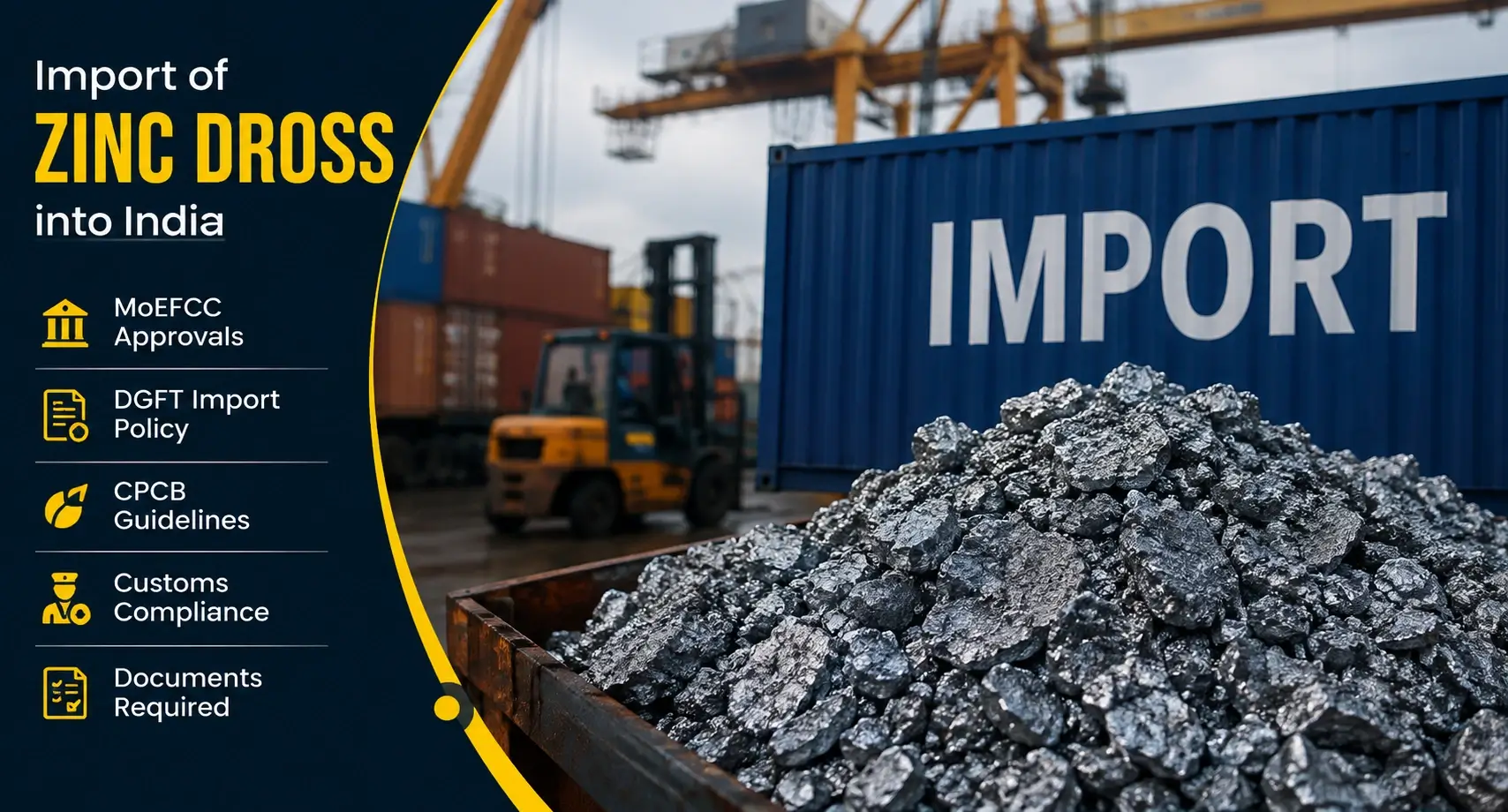
Zinc dross Process is commonly used as an imported secondary source of metal extraction/manufacturing. The classification of this product under Indian laws will determine the applicability of environment law, DGFT import policy, customs laws, and hazardous wastes rules for the import of zinc dross. Before import of zinc dross, one must check its classification under ITC (HS) along with any environmental clearance required for the same.
Ministry of Environment, Forest and Climate Change (MoEFCC)
The MoEFCC is the governing authority for regulating imports of goods under the governance of Indian environmental laws including hazardous and other wastes subject to the Hazardous and Other Wastes (Management and Transboundary Movement) Rules, as applicable.
Directorate General of Foreign Trade (DGFT)
DGFT is the regulatory body for import/export policies of India and this is the best way for you would be to verify the current DGFT Import Policy for the corresponding ITC (HS) code to confirm the classification of zinc dross as freely importable, restricted or licensed product and it always verify the import policy before export.
Central Pollution Control Board (CPCB)
Guidelines and regulations in terms of pollution control and hazardous waste management are made by the CPCB. The respective State Pollution Control Board (SPCB) is yet another authority that needs to be complied with where necessary. This board gives authorization or consent for importations depending on the nature of the facility importing them.
Indian Customs
Indian Customs analyzes paperwork, observes duties, and enforces regulated import activities before giving clearance. The Customs authorities might analyzes classification of the products, environmental approval, licensing issues, and related paperwork during the clearance process.
Documents Required for Zinc Dross Import
Though the documentation to be submitted will differ as per the respective regulations and product classification, generally, importers require:
- Import Export Code (IEC)
- Bill of Entry
- Commercial Invoice
- Packing List
- Bill of Lading/Airway Bill
- Certificate of Origin (if required)
- Approval from MoEFCC (if required)
- DGFT License or Authorization (if required)
- Approvals or Authorizations from SPCB (if required)
- Any other documentation which may be required for Customs or any other Regulatory Authority
Submission of full and correct documentation will aid in quick customs clearance.
Related Import Regulations for Zinc Dross, Zinc Scrap, Zinc Ash, and Metal Scrap in India
While importing zinc dross, along with zinc scrap, zinc ash, and other metal derivatives, in India, it is vital to comply with custom, environmental, and foreign trade laws. For businesses engaging in the trade of zinc scrap, zinc ash, and zinc skimmings, it becomes mandatory to go through the detailed guidelines on import requirements to avoid any delay in the customs clearance of the metal consignment. In addition to obtaining the mandatory approvals, it is also essential to ensure that all the relevant documents accompany the import consignment.
Import Regulations for Zinc Scrap into India
- Ascertain the correct heading code and applicability of import policies.
- Ensure compliance with the Foreign Trade Policy (FTP) and customs laws.
- Check if any environmental clearances are due for the imported consignment
- Make sure that all the relevant documents accompany the imported consignment.
Import Permissions for Zinc Ash in India
- Ascertain if the category of zinc ash being imported falls under any of the waste management rules.
- Make sure to secure the relevant environmental clearances for importing zinc ash.
- Ensure that the specification of the product along with test reports, where applicable, accompany the consignment.
- Comply with all customs and other applicable regulations.
Import Approval for Zinc Skimmings in India
- Ascertain the category of zinc skimmings that are being imported.
- Check if any approvals are required from the relevant authorities for importing zinc skimmings.
- Make sure that all technical specifications of the product are available for reference to facilitate customs inspection.
- Verify the environmental and import clearances for the smooth clearance of the consignment.
Import Export Code (IEC) for Zinc Dross Import in India
- Apply for an Import Export Code (IEC) to obtain the necessary approvals to import zinc dross in India.
- Make sure that the correct IEC number is cited in all import export-related documents.
- Remember to quote the IEC while filing the custom documents and completing other formalities for import approval.
Import Compliance for Metal Scrap in India
- Ascertain the category of metal scrap that is proposed to be imported.
- Make sure to obtain the necessary approvals and permissions for the proposed import consignment.
- Remember to submit the relevant shipping and customs documents while importing metal scrap.
- Maintain a copy of all the submitted documents for future reference and to facilitate customs and compliance audits.
Step-by-Step Process for Importing Zinc Dross into India
1. Determine Product Classification
Ascertain the Harmonized System (HS) code applicable to zinc dross. Check if it falls under a category of recyclable metals, by products or hazardous waste as specified by Indian laws. Check the import policies on the specific category of zinc dross you are considering importing
2. Attain Regulatory Approvals
Ask if clearances from the ministry of environment, forest and climate change or other government agencies are required. You must check if you meet all the environmental regulations for zinc dross imports and get the mandatory approvals before making the consignment.
3. Prepare Import Documents
Give the invoice and packing list for the consignment. Request for the certificate of analysis (COA) or material specification sheet from your supplier. You also need to keep copies of the bill of lading/air waybill, insurance documents and any other certificates or statements required for the customs to clear the consignment. The documents provided must be admissible and describe the goods you are importing.
4. Customs Clearance Formalities
The bill of entry should be submitted to the relevant customs authorities. Submit the required approvals and documents during customs clearance. Allow physical inspection or laboratory testing if directed by customs officials. Settle duties, taxes, and other applicable charges upon entry.
5. Post-Import Compliance
Follow records of approvals, customs filings, and test results for inspection.
Store documents as required by environmental and customs regulations.
Adhere to proper handling, storage, and utilization procedures for the imported zinc dross as mandated by the relevant authorities.
Major Compliance Requirements
For import of zinc dross into India, it is necessary to comply with the following:
- DGFT import policy relevant for the product
- Classification under ITC(HS)
- Environmental guidelines of MoEFCC
- CPCB guidelines, wherever applicable
- Approvals from State Pollution Control Board
- Customs procedures
- Hazardous and other wastes (management and transboundary movement) rules, wherever applicable
Best Practices to Avoid Import Delays
To make sure that there is no risk of non-compliance and any delay while shipping, companies should:
- Ensure that the correct ITC (HS) code has been decided before shipment.
- Have an idea about the DGFT’s import policies.
- Ascertain if MoEFCC clearance is required.
- Obtain SPCB clearances in advance.
- Ensure that all the customs documents are prepared in advance.
- Maintain consistency between the commercial documents.
- Avail the services of experienced customs brokers wherever necessary.
Conclusion
In addition to the clearance of customs, the importation of zinc dross into India requires consideration of a number of other factors prior to shipment. In order to avoid shipment delays and ensure smooth import operations, the businesses should make sure that all aspects of importation, including customs and environmental regulations are taken into account. Following the requirements of the MoEFCC, DGFT, CPCB, SPCB and Customs authorities will help importers avoid regulatory delays and ensure that their imports meet all environmental and customs requirements.
Frequently Asked Questions
-
Does MoEFCC approval need to be acquired for import of zinc dross into India?
Prior MoEFCC clearance may be necessary for the import of zinc dross, depending on the category of dross as per environmental regulations.
-
Is there any need for a DGFT import licence for zinc dross?
The requirement is based on the present DGFT Import Policy and the ITC (HS) Classification. It is important for importers to check the most up-to-date policy prior to shipment.
-
Why is the CPCB role important in imports of zinc dross?
The CPCB has the authority to supervise compliance with the environment and can provide guidelines on hazardous waste management. Depending on the applicable regulations, importers might be required to obtain approvals / authorizations from the State Pollution Control Board.
-
For customs clearance the documents required for zinc dross are ?
The documents required for customs clearance are Bill of Entry, commercial invoice, packing list, Bill of Lading or Air Waybill, DGFT authorization, if any MoEFCC approval, and SPCB approvals (if any).
-
Is zinc dross allowed to be imported into India?
The eligibility is based on the import policy, classification of the product, environmental policies. Importers may be asked to provide proof of compliance with all legal requirements and where relevant, the intended authorized end use of the imports.
-
Which are the most important compliance regulations for the import of zinc dross?
The importers are mandatory to follow applicable DGFT policy, MoEFCC regulations, CPCB/SPCB requirements, Customs process and Hazardous and Other Wastes (Management and Transboundary Movement) Rules (if applicable).
-
What are the ways for businesses to prevent delays in the importation of zinc dross?
Importing zinc dross to India: More than just clearing customs compliance In order to make their work easier businesses can make sure that goods are categorized correctly, all required permits are obtained prior to shipment, all necessary documents are provided and customs and environmental regulations are followed at the time of importation.
-
How can businesses avoid delays in zinc dross imports?
In order to make sure that nothing goes wrong during the transportation of goods, the companies should ensure proper categorization of the zinc dross concerning the import and waste management rules. In addition, preparing necessary documents and permits in advance to avoid extra tests and payments in case of an inspection. It is also essential to check if the documents provided by the supplier are correctly filled out and match all data provided by customs. This way, by following India’s Customs policies, ecological standards, and rules for importing goods, companies will be able to ensure trouble-free processing of their shipments by custom officials.
-
Can traders import zinc dross into India?
Eligibility depends on the applicable import policy and environmental regulations. In some cases, authorities may require proof of the intended end use and compliance with the prescribed import conditions before permitting the import.
-
How long does it take to get MoEFCC approval for zinc dross import?
The approval timeline varies depending on the integrity of the application, document accuracy, and the regulatory review process. Submitting all required documents correctly can help avoid unnecessary delays.