On this page
Introduction
E-waste is the fastest-growing stream of solid waste in India. As consumers seek more electrical and electronic devices, India has been found to produce more than 1.6 million tonnes of e-waste in the past few years. They cause environmental degradation and health risks through the use of toxic elements such as lead, mercury and cadmium through improper disposal.
An E-Waste Recycling Plant is not only another lucrative enterprise but also very essential to the environment. Valuable materials such as copper, aluminium, gold, silver and rare earth elements can be recycled in a professionally managed facility, and this way, hazardous waste can also be discarded safely.
CERTILIZE would provide consultancy and implementation services for the establishment of CPCB-compliant e-waste recycling facilities in India in an end-to-end manner. We put your recycling project through the paces until it is compliant, sustainable and profitable by issuing regulatory licenses, procuring machinery, planning a layout, training workforce and registering with EPR.
Licenses and Certification Required
Various licenses and approvals are required to implement and run an e-waste recycling plant:
- Company Registration
Proprietorship, Partnership, LLP or Pvt. Ltd.
Authority: MCA / Udyam Portal - CTE and CTO (Consent to Establish and Consent to Operate)
An air and water act
Authority: State pollution control board (SPCB) - E-Waste Management Rules 2022 authorisation
To store, de-manufacture, recycle and process e-waste
Authority SPCB / CPCB - Authorisation to transport Hazardous Waste (where necessary)
To deal with the toxic elements of e-wastes
Authority: SPCB - Factory License
It is required when using 10+ labourers and electric energy
Authority: Department of Labour - Fire NOC
In order to comply with fire safety
Municipal Fire Department - Trade License
To undertake manufacturing or processing business
Governance: Local Municipality/ Panchayat - Electricity load authorisation
Necessary to connect industrial loads
Authority: State Electricity Board /DISCOM - GST Registration
Necessary to bill and comply with taxes - Registration of Extended Producer Responsibility (EPR)
Requisite that the e-waste recyclers should accept and handle waste materials of the producers/importers
Directorate: Central Pollution Control Board (CPCB)
Standard Machinery and Approximate Cost
Machinery varies depending on capacity and automation. Below is a standard list for a small to mid-size e-waste recycling plant (1–2 TPD):
| Machinery/Equipment | Purpose | Approx. Cost (INR) |
| Conveyor Belt | Feeding waste into processing line | ₹1,20,000 |
| Shredder/Crusher | Size reduction of e-waste | ₹5,50,000 |
| Magnetic Separator | Removing ferrous components | ₹1,50,000 |
| Eddy Current Separator | Extracting non-ferrous components | ₹3,00,000 |
| Dust/Fume Extraction Unit | Pollution control during shredding | ₹2,50,000 |
| Vibratory Screen/Sorter | Segregation of materials | ₹1,00,000 |
| PCB Dismantling Line | Manual/mechanical removal of circuit boards | ₹2,50,000 |
| Electrostatic Separator | Precious metal recovery | ₹3,00,000 |
| Furnace/Refining Unit (Optional) | Metal smelting and refining | ₹6,00,000 |
| Weighing Machine | Measuring and packing | ₹70,000 |
Additional: ETP, storage racking, CCTV, safety gear, lab equipment, etc
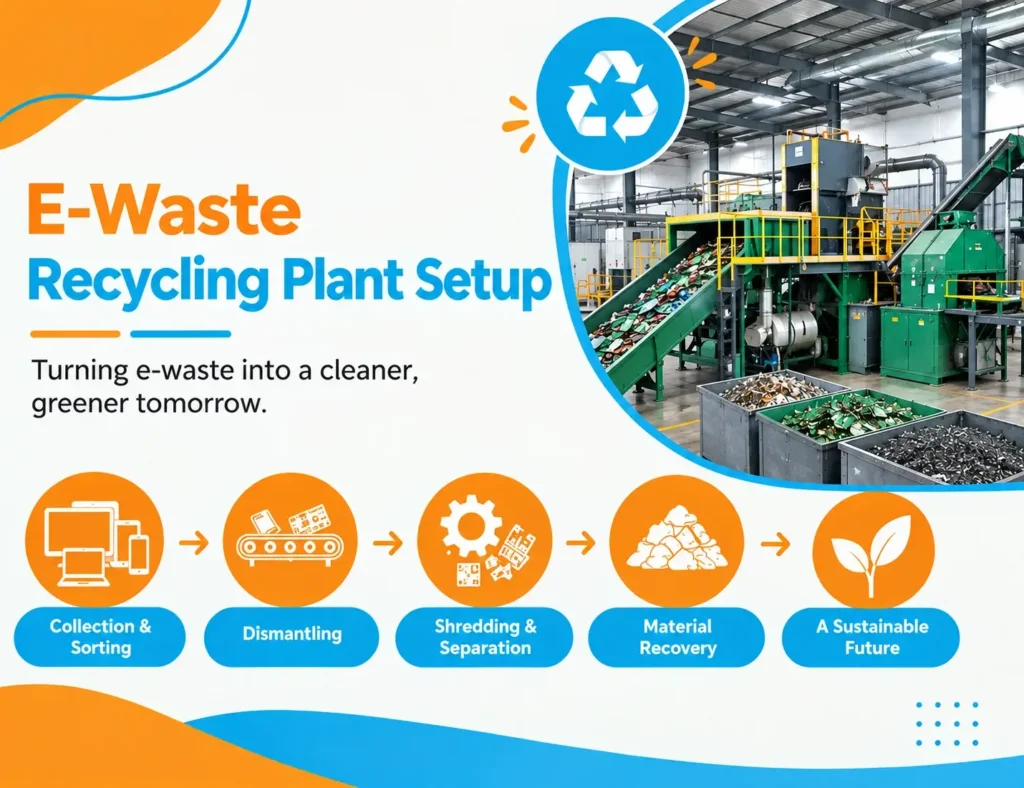
The recycling of E-Waste Process
- Collection & Transportation
Most E-wastes are collected by bulk consumers, authorised dismantlers, collection facilities or take-back systems. - Weighing & Documentation
The garbage is weighed and inputted into a record system according to the guidelines of CPCB. - Sorting & Manual dismantling
The devices are dismantled manually in order to segregate plastic, metals, glass, batteries, and the PCBs. - Shredding Mechanical Separation
Shredding of materials to minimise size and separation of these materials through magnetic and eddy current separators is done. - Precious Metal Recovery
Copper, gold, silver and palladium are the metals recovered in PCBs and connectors either through chemical or electrostatic extraction. - Refining (Optional)
Recycled metals are recycled by melting, refining and turning them into ingots to be sold again. - Hazardous Waste Disposal
Hazardous and non-recyclable waste is taken to the Department of Environment or authorised TSDFs (treatment, storage and disposal facilities). - Final pack and despatch
The recycled materials are balanced, written and sold to the manufacturers or metal dealers.
Market Overview
- India ranks 3rd as the top e-waste generator next to China and the USA.
- The estimated annual growth of the market is at a CAGR of 15-20 per cent.
- E-waste comprises valuable metals such as gold, silver, platinum, copper and rare earth metals.
- Government directives such as the obligation to use EPR and e-waste collection volumes imposed on the producers stimulate demand.
- Massive opportunities with B2B agreements with IT companies, telecommunications businesses, as well as manufacturers concerning the safe disposal of e-waste.
Benefits of EPR (Extended Producer Responsibility)
When you register as an e-waste recycler, you are an influential component of the EPR credit ecosystem. Benefits include:
- Take e-waste brought in by Producers, Importers and Brand Owners (PIBOs) and dismantle/recycle it
- CPCB Portal Based EPR Credits Generation & Trade
- Exposure to long-term deals with MNCs and Indian corporates
- Preferential Status in CSR & ESG linked Bids
- The legal immunity of the penalty for treating waste under the authorisation of the E-Waste Rules
CERTILIZE assists you in enrolling under the EPR portal, making your returns and managing your sales on credit.
So why CERTILIZE?
We offer end-to-end 360 services to set up e-waste plants:
- Registering a business and enrolment of MSME
- Site selection, design and pollution mitigation layout
- CTE, CTO, E-Waste Authorisation, factory License, Fire NOC.
- EPR enrolment, reports, and filing on a monthly basis
- Planning of machinery, selection and importation advice (where necessary)
- DPR and funding support (in case of subsidising or getting a loan)
- Legal documentation and after setup audit support
We have more than 100+ successfully installed plants in waste management in India, and hence full compliance and seamless implementation.
Give us a chance to build your E-Waste recycling plant.
The e-waste industry is a supported sunrise industry with growing waste amounts that are lucrative when it comes to profits. CERTILIZE provides the best and professional advice to put your plant in total legal and technical compliance.
Frequently asked questions
Can one recycle E-Waste in India without CPCB registration?
No. E-Waste recycling operations have to be performed within the law under the E-Waste (Management) Rules, and you have to be licensed by CPCB/SPCB.
How many acres is the smallest area an e-waste recycling plant should have?
Approximately 6,000–10,000 sq. ft. is required for plant operations, storage, and dismantling.
Do precious metals have to be recovered?
Not compulsory. Pollution clean-up is done by a lot of units that just collect and dismantle. There is an option to recover, which takes extra licensing.
What is the daily requirement of e-waste to operate the plant?
An e-waste plant of 1 TPD size will require a constant feed of how many kg of mixed e-waste approximately, 800 - 1200 kg per day.
May I bring in e-waste to recycle?
No. India does not allow the import of e-waste other than for certain exemptions to R&D or reverse logistics.
Do I require a BIS or an ISO certification?
It is not compulsory, but ISO 14001, 45001, and 9001 are recommended to deal with quality, safety and environmental management.
What is the ROI of this business on average?
Depending on scale and sourcing, ROI can be 25–40% within 18–24 months.
Does CERTILIZE assist in connecting with the EPR contract than the producers?
Yes. We even help you to find obligated brands and to register with the CPCB portals.
Does this business require treatment of water?
ETP set up and CGWA consent are needed should the process utilise any quantity of water (e.g. PCB refining).
What is the time of completion for the license and setup?
Usually, 60 to 90 days of complete installation of the license, machinery, and commissioning.